
About
You are invited to attend a special three-day course on design for additive manufacturing (DfAM). Experience DfAM in a special environment in Golden, Colorado – perfect conditions to elevate your design skills!
The course introduces DfAM practices, integrating traditional engineering guidelines with simulation, and optimization tools increasingly used in advanced AM workflows. Participants will learn both foundational design rules and how modern software tools use generative design, machine learning, and automated build preparation to accelerate the development of high-quality, functional AM parts.
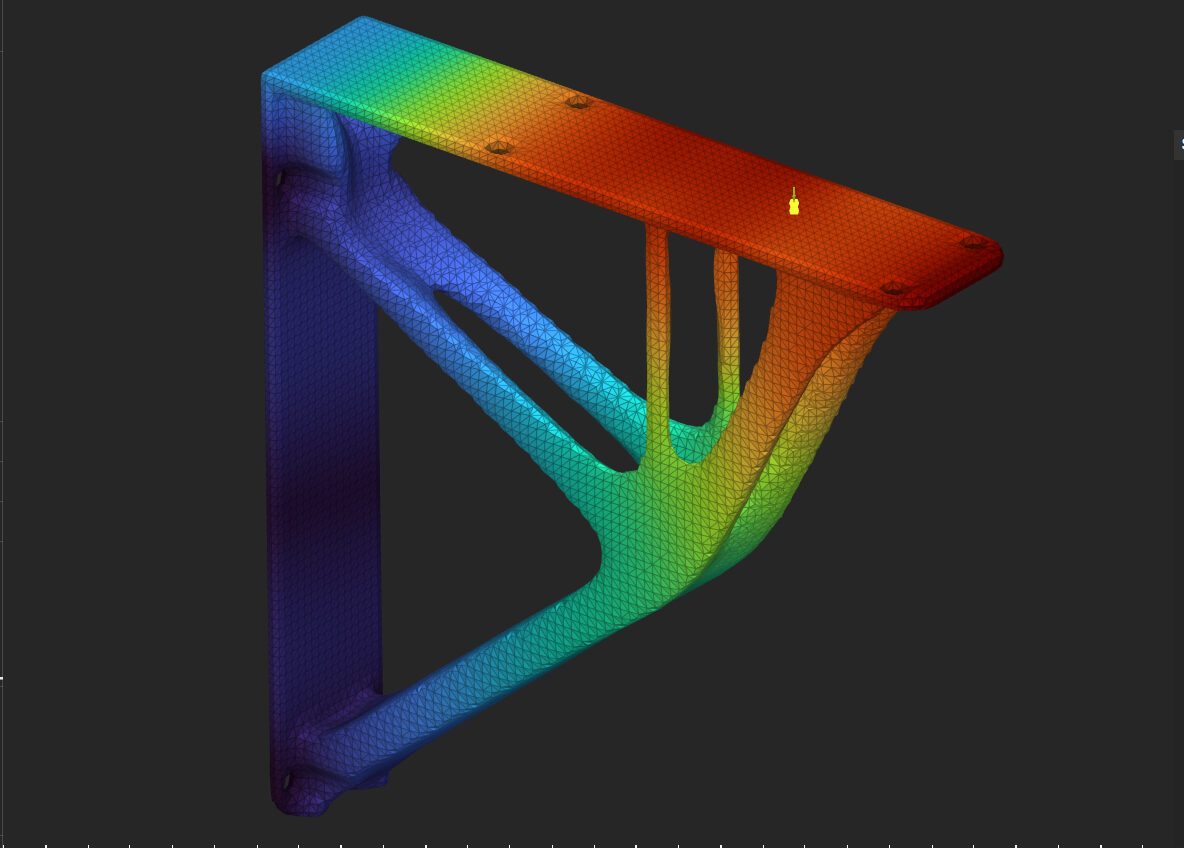
Automatically generated topology optimized bracket. It was created by adding bracket dimensions, with a load resting on the shelf. The bracket was automatically generated to support the loads.
The course covers practical design guidelines developed over the past two decades. Also, it covers how AI-enabled tools can augment engineering judgment during part design, optimization, and process planning. Participants will explore design principles for a wide range of AM processes and materials, with emphasis on producing reliable, manufacturable parts.
Topics include minimum wall thicknesses, smallest diameters for pins and holes, design and printing of screw threads, clearances for moving assemblies, support minimization, and the management of overhanging features. Advanced software tools will be used to analyze shapes and geometric features, perform lightweight design optimization, including lattice structures, suggest design improvements, and optimize parts for performance, weight reduction, and manufacturability.
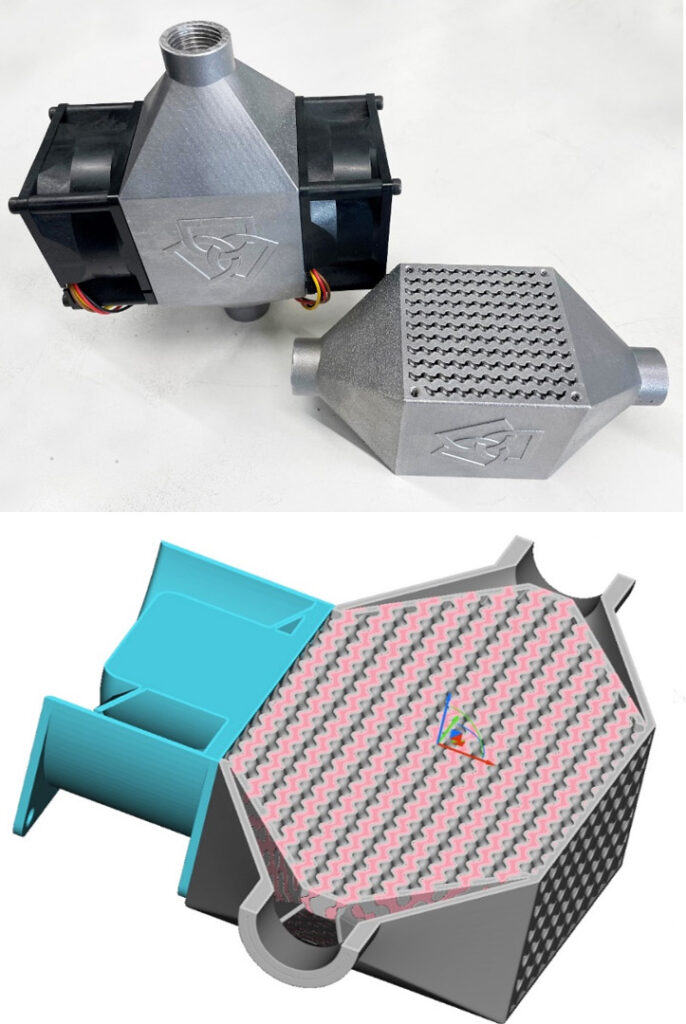
Gyroid-filled radiator. This is a highly optimized radiator, more efficient than a plate and tube radiator three times its size. It was automatically generated in which the user first designed the outer shape and size of their radiator. The CAD model was imported into nTop, which automatically generated the data ready for printing. It is designed to be 3D-printed with almost no support material, reducing post-processing to a minimum.
Hands-on exercises focus on the design of real parts and products, while preparing them for production on industrial AM equipment. Parts will be produced during the course and participants will gain first-hand experience in post-processing the parts (i.e., removing support structures). The course also introduces build preparation workflows, including automated orientation, support material generation, and process parameter recommendations.
Who Should Attend
This DfAM course is targeted at designers, engineers, and managers wanting to learn how to design parts that benefit from AM. It is ideal for those involved in aerospace, defense, healthcare, automotive, motor sports, power/energy, industrial machinery, consumer products, and other sectors.
Participants will gain valuable hands-on experience with the best-in-class software tools, for which licenses will be provided for this course. CAD skills are not required.
Day 1 Agenda
 = Hands-on Exercises
| 8:30-8:45 | Introduction | Introduction and welcome to the course and participants. |
| 8:45-9:15 | State of the AM industry | Recent AM growth trends and developments around the world. |
| 9:15-10:15 | Introduction to design for AM | Benefits of AM in the context of DfAM, how AM is being applied, and how certain parts can be redesigned for AM. |
| 10:15-10:45 | Break | |
| 10:45-12:00 | AM process: from CAD to part | Examining the complete AM process chain, from CAD part creation to part production, and covering the range of AM processes. |
| 12:00-12:45 | Lunch | |
| 12:45-1:30 | Thinking DfAM: Economics of AM | Thought processes behind DfAM and the economics of AM. When does it make sense to use AM for production quantities? What determines AM costs and how are parts designed to minimize expenses? What are the core thought processes behind DfAM? |
| 1:30-4:00 | AM design optimization exercise (hands-on) | Optimize a part to be printed with minimal or no support material. In this exercise, participants will design a metal multitool while considering print orientation and support material. |
| 2:30-2:45 | Break | |
| 2:45-4:00 | AM design optimization exercise (hands-on) | Continued design optimization of multitool |
Day 2 Agenda
= Hands-on Exercises
| 8:30-9:45 | Designing for metal AM | Specific issues and guidelines designing for metal AM, including anisotropy, process constraints, general guidelines on wall thickness, hole sizes, tolerances, and angles. Includes a close look at metal AM post-processing and material properties. |
| 9:45-10:30 | Lattice structures exercise (hands-on) | A solid part is transformed into a shell filled with a lattice structure. This exercise will first be done using Magics and then repeated using nTop as an introduction to the thought process behind the software. |
| 10:30-10:45 | Break | |
| 10:45-11:30 | Designing for polymer AM processes | Specific issues and design guidelines surrounding polymer AM, such as material extrusion, powder bed fusion, vat photopolymerization, etc., and post-processing. |
| 11:30-12:00 | Stress reduction exercise (hands-on) | Redesigning a clamp to minimize the amount of residual stress that might otherwise cause a print to fail. |
| 12:00-12:45 | Lunch | |
| 12:45-1:45 | Post-processing | Understanding various methods of post-processing AM parts. |
| 1:45-2:15 | Computational design (hands-on) | Examining how AI is beginning to impact AM. Understanding the power of automated product development workflows. Introduction to implicit modeling and exercise on designing a heat exchanger with nTop. |
| 2:15-2:45 | Break | |
| 2:45-4:00 | Computational design (hands-on) | Continue implicit modeling exercise on designing a heat exchanger with nTop. |
Day 3 Agenda
= Hands-on Exercises
| 8:30-9:30 | Post processing parts | Post process the parts produced by a service provider and/or desktop printer |
| 9:30-10:15 | Part consolidation exercise (hands-on) | Hands-on exercise on the implications of part consolidation for AM. |
| 10:15-10:30 | Break | |
| 10:30-11:00 | Tooling applications of AM | AM beyond direct part production: Tools for injection-molding, sheet-metal forming, cutting and drilling, extrusion, and jigs and fixtures. Adding fixtures to parts to ease mounting on CNC machines for more efficient post-processing. |
| 11:00-12:30 | DfAM expert panel session | A group of DfAM experts offer opinions and experiences and answer questions from participants. |
| 12:30-1:00 | Lunch | |
| 1:00-1:45 | Topology optimization (hands-on) | Designing topology-optimized parts for AM and creating light-weight parts using the Inspire software. |
| 1:45-2:15 | Break | |
| 2:15-3:15 | AM in the future | Where AM and design software tools are headed in the future and how they may impact DfAM. |
| 3:15-3:45 | Conclusion | Closing comments and distribution of certificates of completion. |
Instructors
-

Wohlers Associates
Olaf Diegel
-

Wohlers Associates
Terry Wohlers


DfAM Expert Panel
-

nureo AG
Manuel Biedermann
-

Colorado School of Mines
Joy Gockel
-

Brunel University of London
Eujin Pei


Register
Registration includes special hand-outs, DfAM guidelines, Wohlers Report 2026, lunches, refreshments, evening reception, 3D-printed gift, and certificate of completion. Limited to the first 25 registrations. Our last DfAM course sold out, so register now.
Questions? Email wa@wohlersassociates.com.
Registration Rates
| Early-bird (before May 1, 2026) | $2,495 |
| Regular rate | $2,995 |