Loading Events

Research to Application Through Standardization

ASTM International Conference on Advanced Manufacturing 2026

September 28, 2026 -October 02, 2026

About

The ASTM International Conference on Advanced Manufacturing (ICAM) is the premier annual forum where the global advanced manufacturing community converges to shape the future of industrial production. ICAM 2026, hosted by the ASTM Global Advanced Manufacturing Programs Division and supported by more than a dozen ASTM technical committees, brings together the leaders, innovators, and practitioners who drive technology from early exploration to industrial deployment.

ICAM focuses on the full lifecycle of manufacturing innovation—pre-industrialization research, standards that support scale-up, and post-industrialization practices that strengthen reliability and performance—across sectors such as aerospace, defense, energy, medical, automotive, and microelectronics. The conference provides a collaborative environment where end users, researchers, government agencies, and solution providers work together to build the consensus, pathways, and implementation strategies needed for advanced manufacturing.

Key focus areas include:

  • Industry standards and shared frameworks
  • Design methods for scalable manufacturing
  • Qualification pathways and responsible adoption
  • Process and system innovations
  • Advanced materials and integrated manufacturing processes
  • Data, modeling, and digital manufacturing ecosystems

ICAM 2026 - General Submission Timeline
Abstract Submission OpensDec 15 (Mon)
Abstract Submission DeadlineMarch 6 (Fri)
Notification to Accepted SpeakersMay 8 (Mon)
Registration OpensMay 1 (Fri)

ICAM is the place where technical decision makers from around the world exchange insights, present leading-edge work, and build the technical and strategic relationships that move advanced manufacturing forward. The conference supports the transition of ideas, methods, and technologies into production-ready solutions, ensuring that innovation isn’t something stuck in a lab, but delivered to the front lines.

Abstracts

This is a unique opportunity to showcase your research and technical expertise to a global audience of industry professionals, academics, and thought leaders.

Authors are encouraged to submit an abstract of no more than 500 words, outlining the scope of their presentation and aligning with one of the conference topics listed below. Accepted abstracts will secure a presentation slot at ICAM 2026.

Submit Your Abstract

Symposia Topics include:

  • Industrial Applications – aviation, space, medical, energy, etc.
  • Value Chain – directed energy deposition, fatigue and fracture, in-situ monitoring, etc.
  • Industry 4.0 – AI/ML, modeling & simulations, security, etc.
  • Non-Metallic Materials – polymers, composites, ceramics, microelectronics, etc.

Selection Criteria

Presentation slots will be allocated based on the merit and relevance of the submissions to the conference agenda. Timings and formats for speaking slots will be finalized as the program is developed, based on the subject matter.

Submissions will be evaluated based on the following:

  • Relevance and importance of the topic to conference attendees
  • Inclusion of an end-user as a lead or co-presenter
  • Objective and educational content
  • Clearly defined benefits for attendees
  • Knowledge and experience of the speaker(s)

Please note:

When submitting your abstract through the submission portal, you will need to select the symposium to which you wish to submit your work. Please be aware that your submission may be reassigned to a different symposium based on its relevance and the number of abstracts already accepted.

Please select “Invited Presenter” only if you have received an invitation from the ICAM 2026 Scientific Organizing Committee.

Additionally, presenters are limited to a maximum of two submissions, and each presenter is allowed only one “invited” presentation.

Students

Download the Student Research Showcase Flyer

ICAM 2026 Student Research Showcase

Full-time/part-time graduate and undergraduate students wil participate in the Student Presentation and Poster Competition that will be held in conjunction with ICAM 2026. Each of the top presentations in the three competition categories will receive $750, and the best overall presentation among them will receive an additional $250.

Submit Your Abstract

*IMPORTANT*
Students can only submit two abstracts in total.
Each abstract must be submitted to a different student category (e.g., each student cannot have 2 abstracts submitted to the Poster Competition).

Abstract Submission DeadlineMarch 6 (Fri)
Notification to Accepted StudentsMay 8 (Fri)
Presentations due for Oral Presentation Competition (Round 01)June 15 (Mon)
Oral Presentation Competition (Round 01) ResultsAugust 3 (Mon)
In-Person Final Evaluations (Round 02)
--- Student Oral Presentation Competition
September 28 (Mon)
Student Poster CompetitionSeptember 28 (Mon)
Student Oral Presentation SessionsSeptember 29 (Tue) – October 1 (Thu)

Sponsorship

Download the Sponsorship Brochure

Why Sponsor ICAM 2026?

ICAM is the gathering point where advanced manufacturing moves from possibility to production. ICAM 2026 brings together the organizations shaping the next decade of industrial capability, uniting research, engineering, and supply-chain leaders around the frameworks and pathways that accelerate real-world adoption.

As a sponsor, your organization is positioned as a strategic partner in this global dialogue, contributing to the technical, digital, and operational foundations that carry technologies from the lab into industrial environments.

Benefits of Sponsoring ICAM

  • Strengthen industry presence with high-value visibility across a global audience of decision-makers

  • Demonstrate leadership in emerging technologies through curated thought-leadership opportunities

  • Build meaningful connections with innovators, end users, and government stakeholders

  • Align with the conversations shaping future manufacturing ecosystems

  • Help advance the frameworks and consensus needed for scalable, production-ready solutions

For inquiries or to secure your sponsorship, contact icam@astm.org.

Symposia

Industrial Sector: Additive Manufacturing, Robotics, and Automation in Construction

Additive Manufacturing, Robotics, and Automation are significantly transforming the construction sector by enhancing operational efficiency, reducing expenditures, improving safety standards, and facilitating adaptability within complex environments. These advanced technologies optimize workflows and mitigate dependence on manual labor; intelligent systems and robotic platforms serve to advance innovation in Industrialized Construction (IC). Concurrently, Additive Construction (AC) is revolutionizing both prefabricated and on-site procedures through sophisticated hardware, software, and material delivery solutions, supporting terrestrial development initiatives while also laying the foundation for future extraterrestrial habitats. 

As the industry evolves, the integration of digital inventories, artificial intelligence (AI), Internet of Things (IoT), and circular economy principles is enabling smarter resource management and more sustainable practices. Emerging standards and compliance frameworks are supporting the safe and scalable deployment of these technologies in the field.  

This session offers a forward-looking perspective on how construction is advancing—on Earth and beyond—through the adoption of transformative tools and methodologies.

Industrial Sector: Aviation, Aeronautical Systems, and Uncrewed Aerial Vehicles

The aviation industry, including crewed aircraft and the rapidly expanding sector of uncrewed aerial vehicles (UAVs), continues to expand its use of advanced and additive manufacturing technologies, yet significant opportunities remain to fully realize the benefits across all applications. The potential is undeniable, with key drivers including cost savings, schedule optimization, functional improvements and weight reduction particularly as manufacturers seek to redesign existing components, consolidation of part counts, introduce new design concepts and enable on-demand manufacture of spares.  

Progress in material developments, process stability, digital process controls, and data-driven design methodologies is accelerating adoption and demonstrating the potential for AM to support both emerging and legacy aviation applications. Despite this progress, challenges persist as the industry works to integrate AM into high-criticality structures and flight-critical applications. Qualification and certification, supply-chain readiness, economic viability and industry-wide acceptance remain central barriers across crewed and uncrewed systems alike.   

As technology and applications mature, it is essential to evaluate the effectiveness of current practices, identify gaps and determine where standards, regulatory guidance and digital manufacturing frameworks need to evolve to support safe, consistent and cost-effective implementation across aviation, including UAV operations and autonomous air systems.  

Industrial Sector: Defense and National Security Applications

Additive manufacturing (AM) is rapidly transforming defense sustainment and logistics by enabling agile, resilient, and pointofneed production. Barriers to this transformation are process variability, lengthy qualification and certification pathways, education and workforce development, among others. This symposium will convene leaders from defense agencies, industry, and end users to discuss emerging technologies, success cases, lessons learned, and pathways for scaling AM in mission critical contexts. The symposium will explore how AM technologies can strengthen operational readiness, reduce logical risk, and reshape the defense industrial base and operational environments.

Industrial Sector: Energy, Maritime, and Offshore Manufacturing

Additive manufacturing (AM) technology has gained considerable popularity in the Energy, Maritime, and Oil & Gas (EMOG) industries to move beyond prototyping and into production parts for specific applications and requirements. In comparison to the aerospace, automotive, and medical industries, the adoption of AM in the EMOG industries has been moderate and is still very nascent. However, these sectors are aggressively exploring the potential of using AM to improve supply chain lead-time, performance, and operational efficiency. These industries face some unique challenges that other; more AM advanced industries do not encounter. Standard development bodies (e.g., API 20S) have already established frameworks around AM part adoption in EMOG. However, certification and qualification of these parts in extreme environments are still to be defined and established. Many stakeholders in EMOG industries have already demonstrated the capabilities of using AM to produce high-performance components, which has triggered increased interest in more components in higher safety requirements within these industries. 

Industrial Sector: Ground Transportation and Heavy Machinery Innovation

The ground transportation (on and off road) and heavy machinery industries are looking at additive manufacturing (AM) to provide benefits through redesign and part consolidation of existing components/systems to improve performance and cost and mitigate lead time issues with casting and forging supply chains Successful applications have focused on spare parts, rapid tooling, and solutions for low-volume production applications such as customization, but high-volume production and larger components remain a challenge for AM implementation Barriers to adoption include the cost of AM production tied to large capital investment and low AM build rates, the need for suitable and cost-effective materials, and a lack of materials and process data and standards, leading to lengthy and costly qualification.  

Industrial Sector: Medical and Biomanufacturing

The medical industry has for many years been and remains a key sector that takes advantage of additive manufacturing (AM) as a mainstream fabrication technology. AM’s unique capability to rapidly and on-demand fabricate devices with complex, personalized (e.g., patient-specific) geometries that benefit from an increasingly diverse array of materials has enabled the ever-growing adoption of this technology in the facilitation of new medical applications. However, despite a growing number of applications and the tremendous opportunities that AM offers, the full potential of utilizing AM in the medical industry has yet to be fully explored.  

Advancements in point-of-care manufacturing, regenerative medicine, hybrid manufacturing strategies – merging of AM with other modalities or materials, medical education, health monitoring, diagnostic tools, and surgical planning are enabling the broader adoption of AM within the medical industry. In addition, the expanded use of AM within the medical industry requires special attention in the development of new standard and regulatory protocols for imaging, inspection, qualification, and quality assurance to utilize these manufacturing methods in commercial applications.  

Industrial Sector: Space and In-Space Manufacturing

Spaceflight is a unique industry that utilizes several forms of advanced manufacturing to its fullest potential, often resulting in geometrically complex and integrated designs that can only be fulfilled by these processes that include additive manufacturing (AM). Structural integrity, new materials, and novel designs are key enablers for, and by, AM; however, there is a need to revise current standards, qualifications, and certification practices before they can be fully leveraged for AM parts used in spaceflight applications.  

Industry 4.0: Artificial Intelligence, Machine Learning, and Data-Driven Manufacturing

The acceleration of AI and machine learning (ML) technologies in recent years is reshaping how additive manufacturing (AM) is designed, controlled, qualified, and scaled. 

 AM continues to generate large volumes of heterogeneous data across the product lifecycle, from design and simulation to process planning, in-situ monitoring, post processing, inspection, and service performance. The growth of this data ecosystem, combined with advances in deep learning, physics informed models, and generative AI, is creating new opportunities for automation, optimization, and decision support in AM. 

 At the same time, the community continues to face challenges with data quality, interoperability, security, model validation, and trustworthiness, all of which are essential for industrial adoption and certification of AI-enabled AM workflows. 

This symposium brings together experts from academia, industry, and government to explore emerging methods, datasets, standards, and applications that advance AI and ML in AM and help the field move toward more intelligent, scalable, and production-ready manufacturing systems. 

Industry 4.0: Modeling, Simulation, and Digital Twin Ecosystems

This symposium highlights advances in modeling, simulation, and digital twins for qualification and certification of higher criticality additive manufacturing parts (e.g., powder-bed fusion, directed energy deposition, etc.). Emphasis is on mid-TRL (technical readiness level) models and simulations that, once matured, will enable industry and government to expand model-based qualifications and certifications for practical applicationsContributions should demonstrate best practices such as verification, validation, uncertainty quantification, uncertainty reduction, sensitivity analysis, and demonstration problems.  

Industry 4.0: Security, Trust, and Cyber Resilience

As use of AM equipment continues to grow and be more interconnected with Industry 4.0, the risks of cyber and cyber-physical attacks is increasing, including threats such as intellectual property theft, counterfeit products and the illicit production of 3D-printed weapons. These threats pose significant challenges to safety, economic stability, and supply chain security. Traditional security measures might not always be adequate, requiring a comprehensive approach that addresses digital rights management, design protection, and the potential misuse of AM technology. Strengthening AM security will enhance trust in AM-produced parts and support wider adoption. This symposium examines these security concerns within the evolving Industry 4.0 landscape. 

Non-metallic Materials: Ceramics, Microelectronics, and Semiconductors

This symposium explores advances across ceramic additive manufacturing (AM), microelectronics, semiconductor-related applications, and multi-material AM systems that integrate structural and functional performance. As AM technologies mature, the intersection of ceramics, electronics, and semiconductor manufacturing has become a critical frontier for high-temperature systems, UHTCs, power electronics, heterogeneous integration, multifunctional components, and next-generation device architectures. 

This symposium welcomes contributions that address materials, processes, design methods, reliability, and novel applications enabling complex geometries, enhanced thermal and mechanical capabilities, embedded electronics, and high-value semiconductor-adjacent technologies. Topics include progress in AM ceramics, ceramic composites, AME (additively manufactured electronics), microfabrication approaches, multi-layer/multi-material integration, and emerging pathways for electronic and semiconductor device manufacturing using AM. 

Non-metallic Materials: Polymers and Composites

This symposium addresses advancements in polymer and composite additive manufacturing, focusing on material and process standardization, mechanical performance, and testing protocols. The need for documented design, analysis, qualification and certification methods, novel applications, and requirements for a trained workforce are also critical areas for discussion. In addition, this symposium will highlight the maturation of additive manufacturing technologies and processes with polymers and composites, and how they work to produce complex geometries with suitable structural and functional properties 

Value Chain: Advanced Topics in AM: Qualification, New Materials, Post-Processing, and Innovation

Additive manufacturing (AM) facilitates the establishment of rapid qualification and certification of processes, materials, and components.  This symposium offers a forum for discussion of the pathway from traditional to rapid qualification and certification, as well as development of new materials, post-processing techniques for AM, and other innovations such as new AM processes or applications.    

Value Chain: Design for Additive, Advanced, and Hybrid Manufacturing

One of the critical success factors to making the most out of Additive Manufacturing (AM) is to utilize Design for Additive Manufacturing (DfAM) fundamentals and optimization techniques to take advantage of the design freedom that additive manufacturing enables. As AM technology evolves, design and optimization go beyond the traditional user-CAD input. Engineers also need to factor in stress analysis, thermal analysis, process simulation, microstructural evolution modeling, material-process-microstructure-property relationships, and cost estimation to effectively influence the design of AM components. Understanding and applying DfAM fundamentals and current state-of-the-art optimization and AI techniques are critical to creating quality, value-added solutions, accelerating the adoption of AM, and reducing the time and cost of AM implementation. 

Value Chain: Directed Energy Deposition: Process Science, Repair, and Applications

Directed Energy Deposition (DED) is rapidly advancing as a key additive manufacturing (AM) technology, offering unique capabilities for component fabrication and repair. While aerospace, energy, mining, marine, and construction sectors have already embraced DED, its adoption is expanding into tooling, defense, and other advanced manufacturing applications, driven by its ability to improve manufacturing efficiency, material flexibility, and part longevity. 

This session will bring together experts, researchers, and industry leaders to explore key advancements, challenges, and innovations in DED technology, discussing the latest trends, breakthroughs, and its expanding role in modern manufacturing. 

Value Chain: Extreme Environments, Corrosion, and Performance Durability

Environmental and corrosion behavior of additively manufactured alloys remains an underexplored but critically important area for ensuring reliable service performance. While AM research has traditionally emphasized microstructure and mechanical properties, environmentally driven deterioration, including corrosion, hydrogen embrittlement, stress-corrosion cracking, and corrosion-fatigue, often governs the service life of a component. AM materials can exhibit distinct microstructures and degradation mechanisms when compared with conventionally processed alloys. (casting, forging, etc.). The application of post-processing methods, such as heat treatment, surface finishing, and coatings may influence material properties, and therefore enhance component performance. Another issue to be considered is that most characterization efforts rely on legacy corrosion-testing standards, which may not fully account for the unique microstructures and new materials produced by AM. While often applicable, these standards may require additional considerations or adaptation to ensure accurate evaluation of AM alloys. 

Value Chain: Fatigue, Fracture, and Structural Integrity

Additive Manufacturing (AM) technologies are increasingly used to produce functional components in applications such as medical, aerospace, automotive, energy, defense, and consumer electronics. However, their adoption in safety-critical parts within regulated sectors, such as civil aviation, remains limited. A major barrier is the need to mitigate risks associated with AM-specific material defects, requiring novel, sustainable, and robust characterization methodologies, including validated experimental models and predictive software for fatigue behavior. Developing these tools for safety-critical applications relies on a fundamental understanding of how AM microstructures and defects (e.g., sub-surface porosity, lack of fusion, and surface notches) affect component structural integrity. However, progress has been hampered by the lack of historical data, process-driven variability, and the rapid pace of technology development. We are convening at ICAM26 to share new discoveries, analyses, and case studies to advance qualification and certification as well as the safe use of AM components in fatigue-critical applications. We invite all subject-matter experts to submit abstracts focused on fatigue and fracture of AM parts. 

Value Chain: Feedstock Innovation: Characterization, Specification, and Reuse

Additive manufacturing (AM) feedstocks are available for a broad range of material types and come in various forms (e.g., powder, wire, filament, inks). New offerings are continuously introduced to the market with varied and unique characteristics. In some cases, the impact of feedstock characteristics on the process and part quality are not fully understood quantitatively. Therefore, a proper understanding of AM feedstock characteristics and the quantification of their performance during manufacturing is essential for the production of AM parts with repeatable quality, be it for fresh or reused feedstock materials. New characterization methods, acceptance criteria, and standards need to be developed for the complete and reliable characterization of feedstock materials.  

Value Chain: In-Situ Monitoring and Process Control

In-situ monitoring and in-process control are becoming essential to industrial Additive Manufacturing, enabling improved quality, higher yields, reduced post-process inspection, and faster qualification. This symposium welcomes work spanning  all AM technologies on new sensing approaches, multi-modal data fusion, intelligent control, data validation, integration with modelling and digital twins, and case studies showing how in-situ data can drive process optimization, accelerate development, support NDE, and enable qualification and certification. 

Value Chain: Microstructure-Property Relationships and Mechanical Behavior

The unique microstructural features and potential defects in metallic components fabricated by additive manufacturing (AM) result in key performance metrics and characteristics that may differ from their conventionally manufactured counterparts. These distinctive features include strongly textured microstructures, AM specific material flaws, surface irregularities, and more. 

To understand the impact of these unique AM microstructural and features on the material properties and consequently on parts performance, it is crucial to conduct thorough investigations through physical testing, as well as developing material models to simulate AM processes and resultant properties. While established testing standards exist for deriving various mechanical properties, it has become evident that conventional procedures may not always be applicable to AM materials due to the unique nature of the fabrication process. 

This symposium aims to address the challenges posed by the unconventional thermophysical phenomena, mechanical characteristics and property dependencies observed under different conditions, such as various geometries, process parameters, and post-processing. The topics covered in this symposium will delve into these crucial aspects, providing insights into the complexities associated with the microstructural characteristics of AM materials and their implications on overall material properties and parts performance. 


Value Chain: Non-Destructive Evaluation and Inspection

While destructive evaluation methods such as mechanical testing and microstructural characterizations are often used to evaluate the mechanical performance of additively manufactured (AM) materials and parts, non-destructive evaluation (NDE) methods can provide significant insights without the need for sectioning and damaging the part. Since the presence of defects (e.g., pores, lack of fusion, surface roughness, etc.) often influences the mechanical performance of AM parts significantly, understanding the critical characteristics (such as type, size, and distribution) and location of these defects is key to managing performance expectations, and qualification and serviceability. NDE methods can also be leveraged for the quantification of material properties. 

Value Chain: Sinter-Based Technologies and Applications

Sinter-Based Additive Manufacturing (SBAM) processes offer improved resolution and surface finish, wider choice of materials, and increased build speed compared to fusion-based AM processes, resulting in lower production costs and enabling new applications. Sinter-based AM processes now include several technologies as defined in ISO/ASTM 52900: Binder Jetting (BJT), Material Extrusion (MEX), Material Jetting (MJT), and Vat Photopolymerization (VPP). There is also the emergence of several new SBAM technologies such as hybrid processes that rely on both additive and subtractive processes, 3D Screen printing, and 3D printing of multi-materials. Unique to these sinter-based processes, the powder feedstock is selectively bound together with a binding agent during the printing process to produce what is commonly referred to as a “green” part. Secondary debinding and sintering steps are then required to remove the binding agent and consolidate the powder material to the desired final part density. While the potential of these new technologies is high, there are still challenges being addressed to achieve the economy and scale these technologies promise and standardization needed to reach a positive inflection point in industry adoption 

Value Chain: Strategy, Techno-Economics, and Sustainability

Additive manufacturing has developed from a prototyping technology to an impactful range of production technologies that offer businesses and governments the potential for new options in manufacturing and sustainment strategies.   Ever-present economic drivers combined with an increased global focus on the environmental impact of manufacturing and evolving government policies toward trade and re-shoring provide a clear and present opportunity for end users to realize the benefits of additive manufacturing and other flexible advanced manufacturing technologies. 

Technology adoption strategies are often inextricably linked to economic outcomes, government policies, or environmental responsibility.. Analyses and presentations which explore adoption strategy and/or the underly economic and social drivers that prompt adoption (quantitatively and/or qualitatively) will provide a clearer impact-based understanding of where advanced manufacturing is headed. 

Organizers

Co-Chairs

Nima Shamsaei, Director – National Center for Additive Manufacturing Excellence (NCAME), Auburn University

Mohsen Seifi, Vice President of Global Advanced Manufacturing Programs, ASTM International

Scientific Organizing Committee
First NameLast NameOrganizationCountry
ChrisAdkinsMaterialiseUSA
ShawnAllanLithozUSA
RonaldAmanAmaeroUSA
MohammadAmjadiArkansas Tech UniversityUSA
NarasimhaAnnapareddyTexas A&M UniversityUSA
JavierArreguinGE Aerospace - AP&CCanada
CindyAshforthFederal Aviation AdministrationUSA
AmitBandyopadhyayWashington State UniversityUSA
ChadBeamerQuintus TechnologiesUSA
AllisonBeesePennsylvania State UniversityUSA
StefanoBerettaPolitecnico di MilanoItaly
AliBonakdarUniversity of North Carolina at CharlotteUSA
AnimeshBoseAMfgLabsUSA
JesseBoyerPratt & WhitneyUSA
DanielBraleyBoeingUSA
FrankBrücknerFraunhofer IWSGermany
JimmyCampbellPlastometrexUnited Kingdom
EfrainCarreño-MorelliUniversity of Applied Sciences and Arts Western SwitzerlandSwitzerland
ThomasChittumSoundThinkingUSA
ArmandoCoroITP AeroSpain
PeterCouttsPennsylvania State UniversityUSA
BrandonCoxHoneywellUSA
SophieCoxUniversity of BirminghamUnited Kingdom
ElliottCramerNASA - Langley Research CenterUSA
EnriqueCuan-UrquizoTecnológico de MonterreyMexico
CoryCunninghamBoeingUSA
CarloDe BernardiConocoPhillipsUSA
PascalDe GuioSNCF ReseauFrance
DavidDeanOhio State UniversityUSA
EugeneDemaitreThe Robot ReportUSA
NicholasDerimowNISTUSA
MatthewDi PrimaU.S. Food and Drug AdministrationUSA
JimDobbsBoeingUSA
MartinDoplerMetalpineAustria
ChristoDordlofvaGKN AerospaceSweden
BenDuttonManufacturing Technology CentreUnited Kingdom
GeneEidelmanAzure Printed HomesUSA
AmyElliotOak Ridge National LaboratoryUSA
AlaaElwanyTexas A&M UniversityUSA
ThomasFabianBlue Sky Polymer ConsultingUSA
RamonaFayazfarOntario Tech UniversityCanada
OmarFergani1000 KelvinGermany
BrianFisherRTX Technology Research CenterUSA
TonyFryNational Physical LaboratoryUnited Kingdom
ElianaFuTrumpfUSA
SamuelGatleyNew Jersey Institute of TechnologyUSA
LauraGilmourLG StrategiesUSA
AngelineGohShellThe Netherlands
SanamGorgannejadLawrence Livermore National LaboratoryUSA
PaulGradlNASA - Marshall Space Flight CenterUSA
TysonGregoryNidec Machine Tool AmericaUSA
PaulGuerrierMoogUSA
JhonattanGutjahrTWIUnited Kingdom
MichaelHaasFerRoboticsUSA
AzadehHaghighiUniversity of Illinois ChicagoUSA
EvanHandlerNaval Surface Warfare Center - Carderock Division
America Makes
USA
SaschaHartigGerman NavyGermany
TamasHavarGulfstream AerospaceUSA
MichaelHeidenSandia National LaboratoriesUSA
JessicaHemondTE ConnectivityUSA
FrankHeroldVisiConsultGermany
CallieHigginsNISTUSA
SimonHögesGKN AdditiveGermany
PatrickHowardGE AerospaceUSA
NikHrabeNISTUSA
BradleyHughesGKN AerospaceUnited Kingdom
MingJen TanNanyang Technological UniversitySingapore
ThomasJonesRolls-Royce SubmarinesUnited Kingdom
ColtonKatsarelisNASA - Marshall Space Flight CenterUSA
AliKazemianLouisiana State UniversityUSA
RobertKellyUniversity of VirginiaUSA
KennethKimbleNIST USA
RyanKircherrms CompanyUSA
DarrickKristichSedaraUSA
MatthewKrohnPennsylvania State UniversityUSA
VittoriaLaghiUniversity of BolognaItaly
MariusLakomeicEOSGermany
FernandoLasagniNovaindefSpain
AnteLausicGeneral MotorsUSA
SweeLeong SingNational University of SingaporeSingapore
Jia (Peter) LiuAuburn UniversityUSA
ElenaLópezFraunhofer IWSGermany
Taisia (Asya)LouBoeingUSA
YanLuNISTUSA
MorganMaderJoby AviationUSA
TakashiMaeshimaToyota Central R&D LabsJapan
RussellMaierNISTUSA
IslamMantawyRowan UniversityUSA
ThierryMarchioneCaterpillarUSA
BiancaMaria ColosimoPolitecnico di MilanoItaly
GrahamMathesonOerlikon AMGermany
TravisMayberryDivergent 3DUSA
SimonMcCaldinAuthentiseUnited Kingdom
SeanMcEligotMayo ClinicUSA
MichaelMeliaSandia National LaboratoriesUSA
AndreyMolotnikovRoyal Melbourne Institute of Technology/Additive AssuranceAustralia
SherriMonroeAdditive Manufacturer Green Trade AssociationUSA
DiegoMontoya-ZapataEtxetarSpain
NicholasMuléBoeingUSA
JoseMuñizEquispheresCanada
ShahroozNafisiRocket LabUSA
SoumyaNagOak Ridge National LaboratoryUSA
PhillipNagel3D SystemsUSA
KarlNelsonStratasysUSA
ThomasNiendorfUniversity of KasselGermany
AmirNobariTeknaCanada
AndrewNormanEuropean Space AgencyThe Netherlands
IgorOrtizIkerguneSpain
YashParikhEOSUSA
JonathanPeguesAuburn UniversityUSA
RogerPelletierNational Research Council CanadaCanada
MisaelPimentelNational Manufacturing Institute ScotlandUnited Kingdom
BehrangPoorganjiNikon AM SynergyUSA
PaulPrichardOak Ridge National LaboratoryUSA
Xueyong (Kevin)QuThe Aerospace CorporationUSA
PhilipRieglerNorsk TitaniumUSA
TylerRippergerWaygate TechnologiesUSA
ChristopherRobinsonAnsysUSA
DavidRosenA*STAR - IHPC / SIMTechSingapore
BradleyRothernbergnTopUSA
WilliamRyanDepartment of Justice (ATF)USA
MattSandersStress Engineering ServicesUSA
LukeScimeOak Ridge National LaboratoryUSA
RaviShahaniConstelliumFrance
ShuaiShaoAuburn UniversityUSA
TiagoSilvaINEGI – Institute of Science and Innovation in Mechanical and Industrial EngineeringPortugal
TimothySimpsonNASA - Langley Research CenterUSA
JutimaSimsiriwongUniversity of North FloridaUSA
ZackarySnowOak Ridge National LaboratoryUSA
JamesSobotkaSouthwest Research InstituteUSA
CalvinStewartThe Ohio State UniversityUSA
MaximilianStrixnerThe Exploration CompanyGermany
NicoleTailleartU.S. Naval Research LaboratoryUSA
AndrewThompsonNorthrop GrummanUSA
LinusTillmannMobility goes AdditiveGermany
ValeriaTirelliAIDROItaly
BailyThomasBoeingUSA
Isabellavan RooyenPacific Northwest National LaboratoryUSA
GuglielmoVastolaA*STAR - IHPCSingapore
BenoitVerquinCetimFrance
JohnVickersNASAUSA
YeWangTE ConnectivityUSA
TimothyWanglerETH ZürichSwitzerland
CindyWatersNaval Surface Warfare Center - Carderock DivisionUSA
ThomasWeißgärberFraunhofer IFAMGermany
GaryWhelanQuesTek InnovationsUSA
ZacharyWhitmanBoeing Commercial AirplanesUSA
WeiXiongUniversity of PittsburghUSA
MostafaYakoutUniversity of AlbertaCanada
MarkYampolskiyAuburn UniversityUSA
ArkadiZikinOerlikonSwitzerland

Highlights

The ASTM International Conference on Advanced Manufacturing (ICAM 2025) was held October 6–10, 2025, at the Westgate Las Vegas Resort & Casino in Las Vegas, Nevada, USA. Hosted by the ASTM International Additive Manufacturing Center of Excellence (AM CoE) and supported by over a dozen ASTM technical committees, ICAM 2025 marked the tenth year of ASTM’s flagship event for additive and advanced manufacturing.
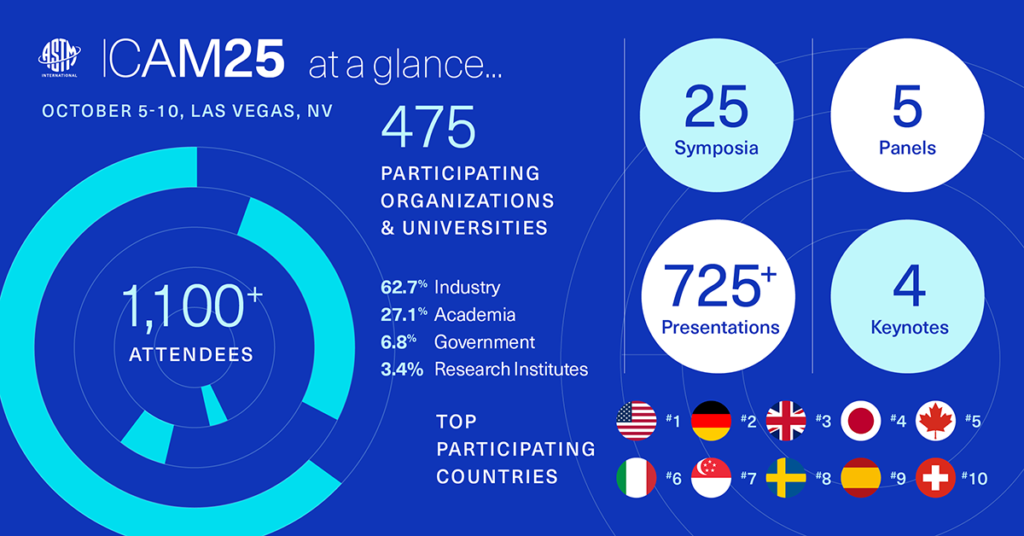
For a taste of last year’s event, watch the videos below:

More highlights can be found on the ICAM 2025 event page.
AM CoE by the Numbers

With decades of experience in additive manufacturing, our team of experts is integral to our work. With team members located throughout the Americas, Europe, and Asia, the AM CoE is able to provide agile support for global initiatives.

BY THE NUMBERS

Partners and Collaborators
27
Technical Experts
32
Projects
40+

How can I participate?

  • Support through Research and Development

    Through the AM CoE, research priorities are identified by the top minds in the field and are matched from the start to the standards that need to be generated to ensure the resulting AM technology’s success.

  • Consortium for Materials Data and Standardization

    Consortia for Materials Data & Standardization (CMDS) enables companies of all sizes from across the entire additive manufacturing ecosystem to collaborate on standardizing the best practices for materials data generation.

  • Explore On-Demand Webinars

    The webinar series provides guidance sessions on multiple and diverse topics in AM Design, Fabrication, Post-processing, Mechanical testing, Non-destructive evaluation, Applications, and Qualification and Certification.

  • Education & Workforce Development

    Comprehensive program that educates and trains the additive manufacturing workforce at all levels, while continually incorporating new advances to respond to industry needs and leverage standardization, certification, and AM CoE partner expertise.